What honest AI disclosure looks like on a small website
There is no legal template for telling readers a model wrote the words. Here is the editorial standard we hold ourselves to — and why it matters more than you think.
 The Wux Webtools Team
4 min read
The Wux Webtools Team
4 min read

Table of contents
The cheap version is everywhere
Go searching for almost any practical question today and you will land on pages that were assembled by a language model in under a minute. Sometimes the model was asked to summarise a real source. Sometimes it was asked to invent one. Either way, the result reads plausibly, the page ranks adequately, and the publisher avoided paying a writer.
The cheap version of AI publishing has three traits in common:
- No disclosure. The reader is not told the page was written by a model.
- No editing. The text was published as the model produced it.
- No accountability. No human name, no bio, nobody to email when the page is wrong.
This is bad for the reader, bad for the open web, and — slightly less obviously — bad for the publisher. Search platforms have started to penalise it, the readership has learned to recognise it, and the long-tail SEO advantage erodes faster every quarter as more sites do exactly the same thing.
There is a better path. It is also not very complicated.
Three commitments that cover most of it
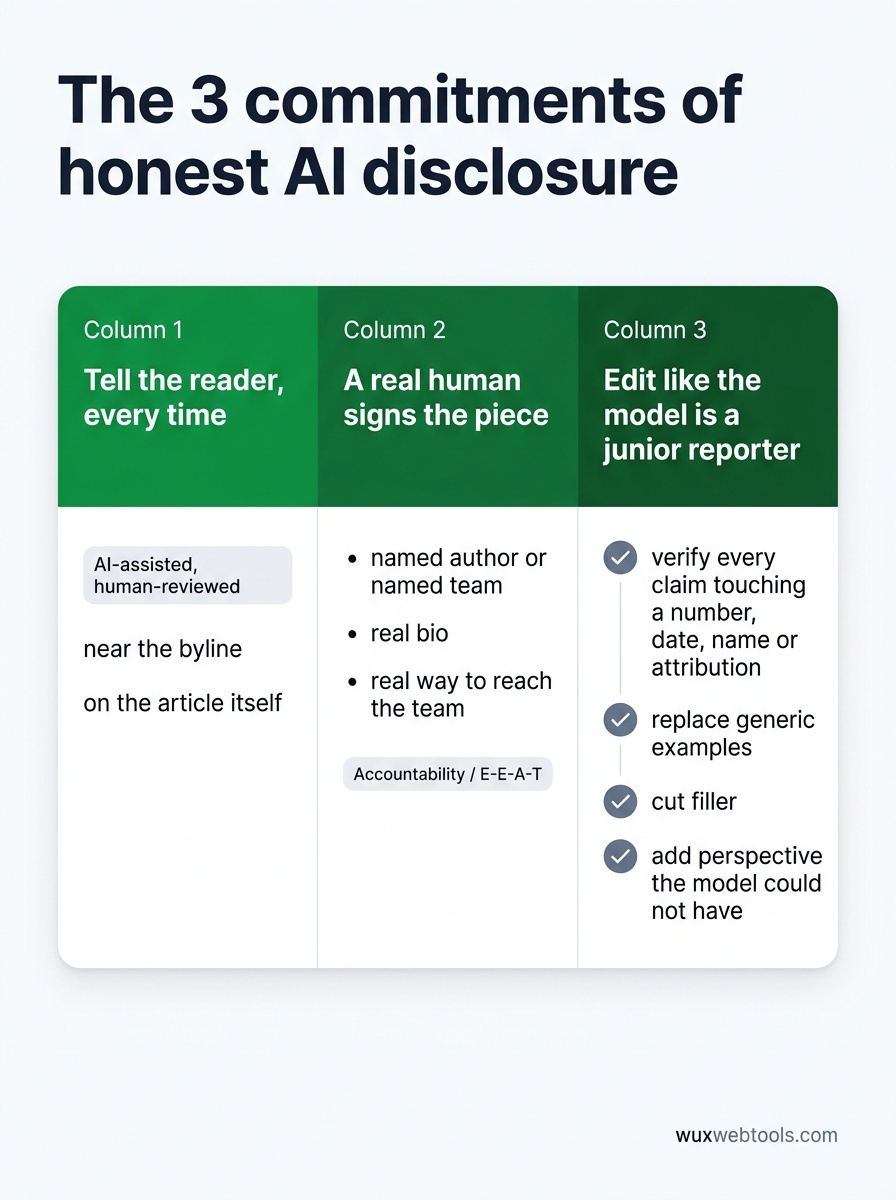
We do use language models on this site for some of our writing — usually as a fast first-draft tool, occasionally for translation, never for fact-finding. The standards below are the ones we hold ourselves to. We do not claim they are the One True Way; we publish them so you can hold us accountable, and so other small publishers have a starting point.
1. Tell the reader, every time
If a model wrote the first draft of an article, the article carries a small badge near the byline that says so. Not buried in a privacy policy. Not in a sitewide footer. On the article itself, where the reader sees it before they trust the words.
The badge does not say "100% AI-generated" because that would be misleading — every article also gets human editing. It says something honest like "AI-assisted, human-reviewed", with a link to a page that explains exactly what that means.
2. A real human signs the piece
Every article has a named author with a real bio, real expertise, and a real way to reach the team. Even when the byline is collective ("The Wux Webtools Team"), the team is identifiable, the editorial standards are written down, and there is a person responsible for what was published.
This is also the part that satisfies the Authoritativeness and Trust sides of E-E-A-T. Search engines look for it now. So do good readers.
3. Edit like the model is a junior reporter
A language model is a fast, confident, slightly unreliable writer. It will produce smooth prose with the wrong fact in it and never raise a flag. The editing pass is therefore not optional; it is the entire point.
A real edit means:
- Verifying every claim that touches a number, a date, a name or an attribution.
- Replacing generic examples with ones the team has actually seen in the wild.
- Cutting filler. Models love three-sentence transitions; readers don't.
- Adding a perspective the model could not have. "In our experience…" is the most expensive sentence in AI-assisted writing, because you have to actually have the experience.
If the article cannot survive that pass — if the editor's job is mostly cosmetic — the article should not be published. Better to have ten honest pieces a quarter than fifty smooth-but-thin ones.
What this looks like on the page
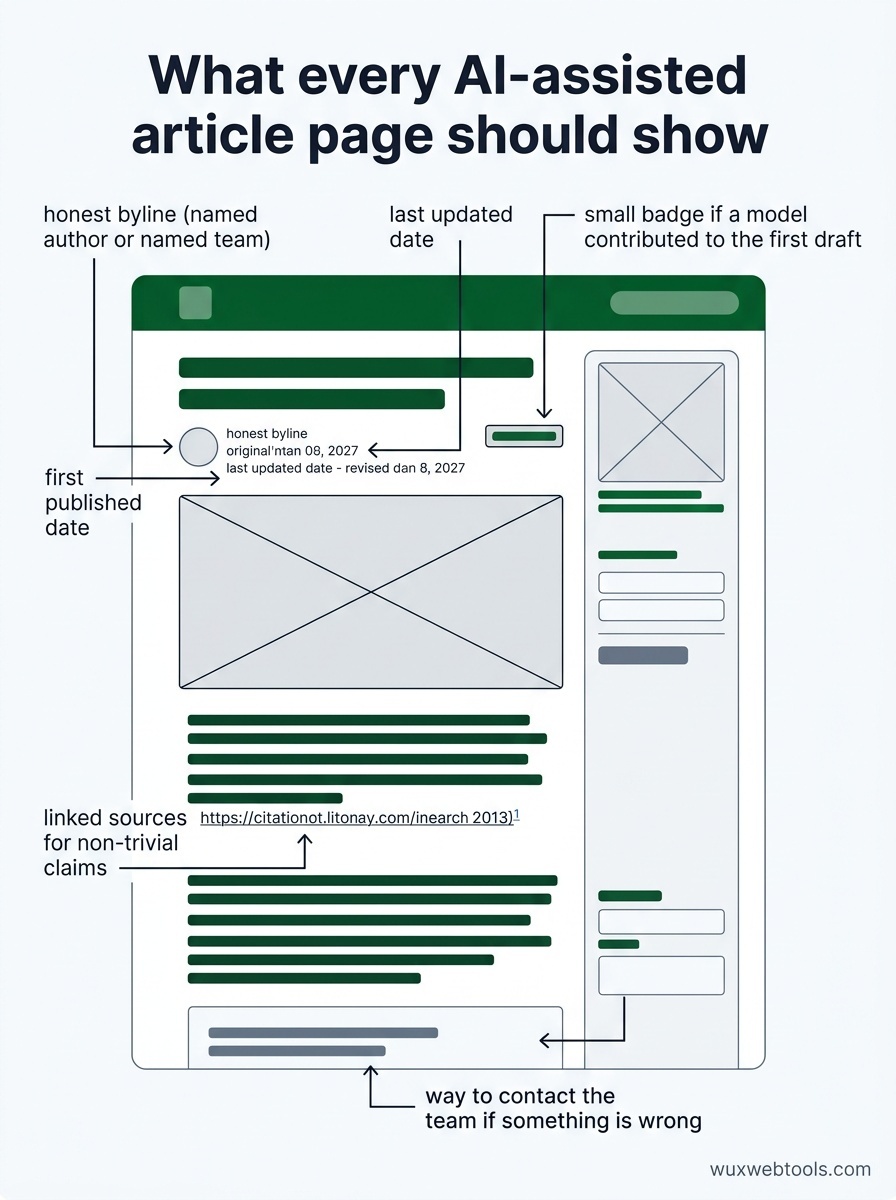
For any reader who wants to verify the standard, every article on this blog should show:
- An honest byline (named author or named team)
- The date it was first published and the date it was last updated
- A small badge if a model contributed to the first draft
- Linked sources for non-trivial claims
- A way to contact the team if something is wrong
If any of those is missing on a piece you are reading right now, please tell us — that is a bug in our process, not a deliberate choice.
<!-- tool-cta:start -->
💡 Try this: If you want to see how visible your AI disclosures are to crawlers, the AI Markdown Checker inspects how a page signals AI involvement.
<!-- tool-cta:end -->
The deeper reason
It is tempting to think of AI disclosure as a defensive move: keep search engines happy, avoid backlash, tick a compliance box. That framing misses the point.
The real reason to disclose is that the trust contract between a reader and a publisher is the most valuable thing a small site has. People give you a few minutes of their attention. They take what you say seriously, sometimes seriously enough to act on it. If they later find out the byline was a fiction — that no human really stood behind those sentences — they don't lose trust in you. They lose trust in the medium. And that loss compounds across the entire open web.
A short, honest sentence on every AI-assisted page is the cheapest insurance against that.
Frequently asked questions
Do I have to disclose if I only used AI for grammar checks?
Won't disclosure hurt my SEO?
What about translations?
What is E-E-A-T and why does it keep coming up?
Sources & further reading