How to detect AI-written content without being a jerk about it
A practical framework for editorial teams who need to spot synthetic text while respecting contributors and avoiding false accusations

Table of contents
- The problem with AI detection tools
- What actually works: editorial judgment plus context
- A fair process for raising concerns
- 1. Review the submission against the brief
- 2. Check for factual errors
- 3. Ask clarifying questions
- 4. Request revisions with specificity
- 5. Have the conversation directly
- When to use detection tools (carefully)
- The broader context: disclosure over detection
- Key takeaways
- FAQ
- Sources
The problem with AI detection tools
Most AI detection tools work by analyzing statistical patterns in text—word frequency, sentence structure, predictability. They return a confidence score, usually presented as a percentage. The problem is that these scores are not diagnostic. A "95% AI-generated" result does not mean the text was written by a machine. It means the text shares certain statistical properties with known AI outputs.
This matters because the consequences of a false positive are severe. Accusing a human writer of submitting AI-generated work damages trust, wastes time, and creates a hostile editorial environment. Students have been failed, freelancers have lost contracts, and job applicants have been rejected based on flawed detection scores. The tools themselves admit they are not reliable enough to be used as sole evidence.
The underlying issue is that AI models are trained on human writing, so they produce text that resembles human writing. As models improve, the statistical distance between human and synthetic text shrinks. Detection tools are chasing a moving target, and they are losing.
What actually works: editorial judgment plus context
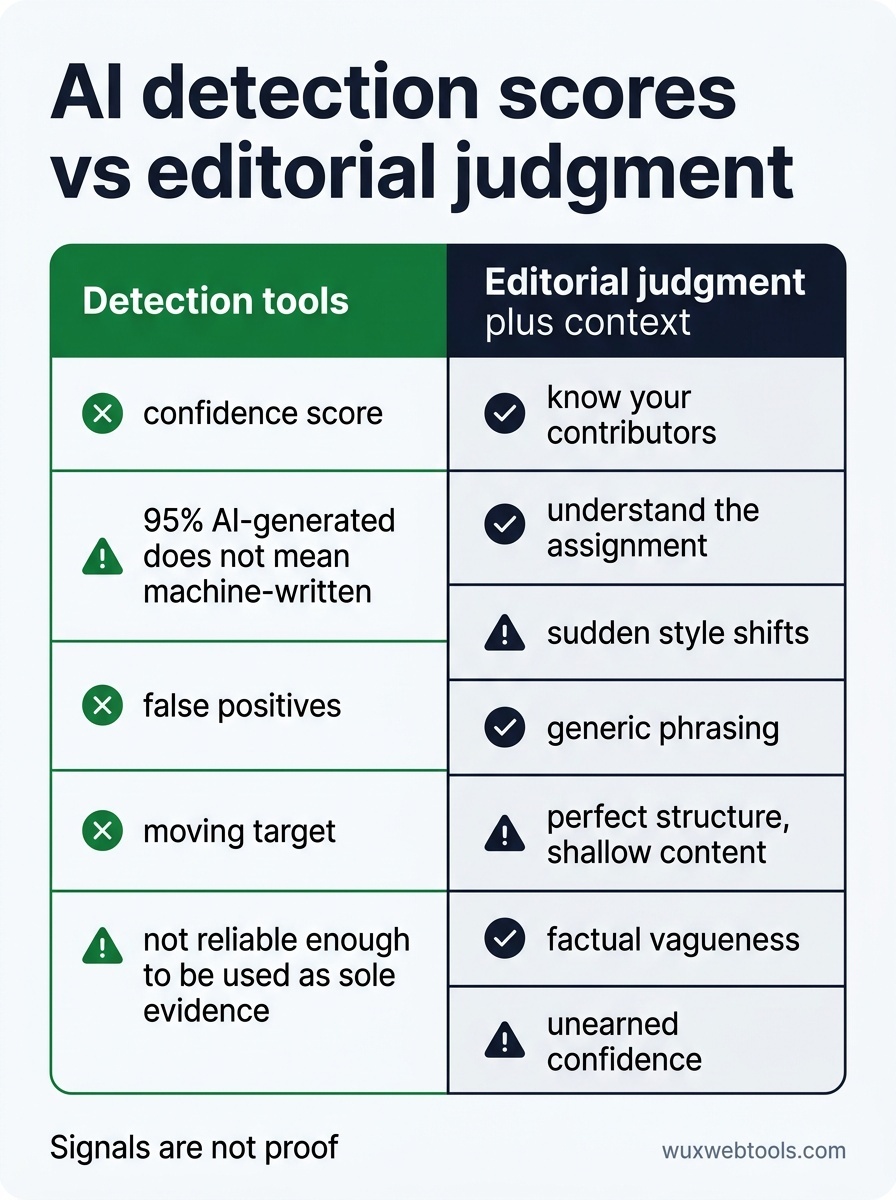
The most reliable way to identify AI-generated content is not a tool—it is editorial judgment informed by context. This requires knowing your contributors, understanding the assignment, and recognizing when something feels off.
Here are the patterns that tend to signal synthetic text:
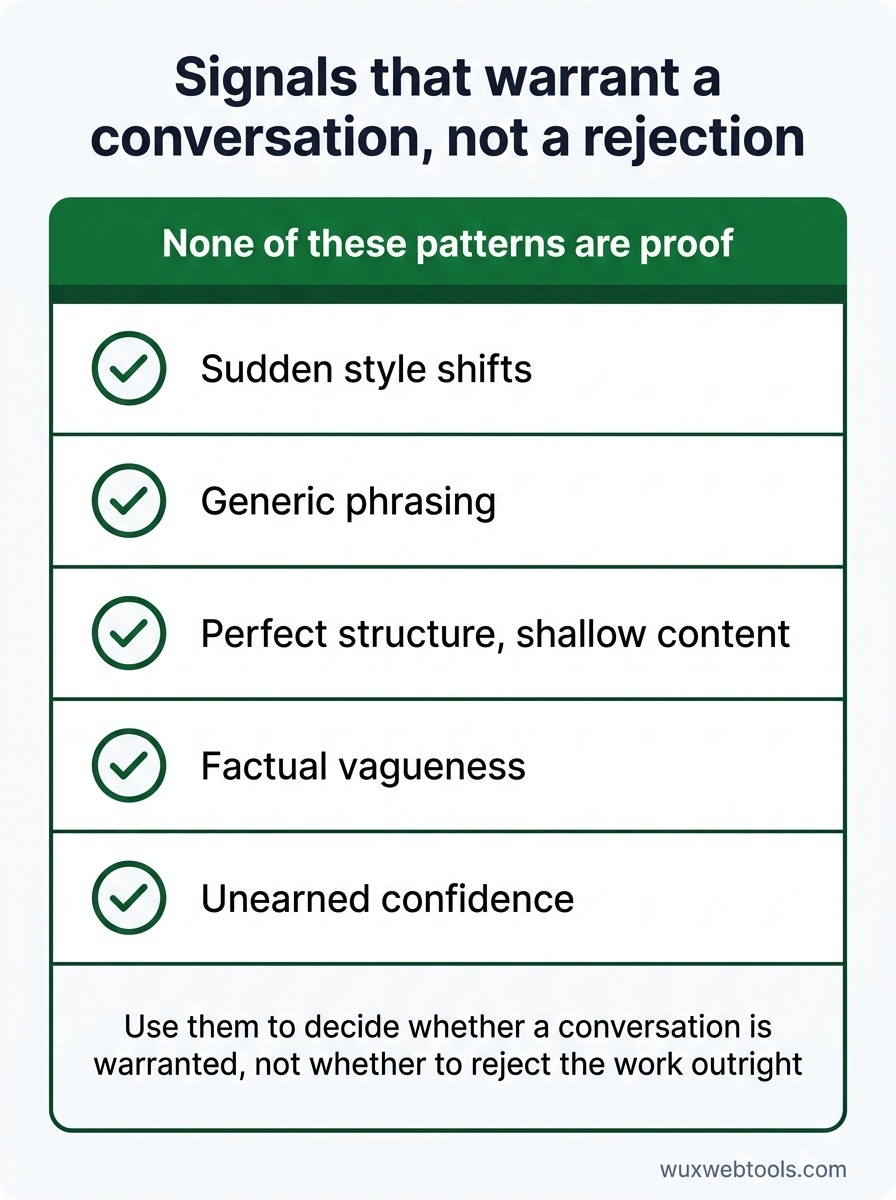
- Sudden style shifts. A writer who normally uses contractions and first person submits formal, third-person prose with no colloquialisms.
- Generic phrasing. The text reads like a summary of summaries. It lacks specificity, avoids strong claims, and uses placeholder language ("various factors," "it is important to note").
- Perfect structure, shallow content. Every paragraph follows the same format. Transitions are smooth but meaningless. The piece looks polished but says nothing memorable.
- Factual vagueness. The text makes broad claims without citing sources, avoids dates and names, and hedges constantly.
- Unearned confidence. The tone is authoritative, but the content is superficial. The writer sounds like they are explaining something they do not understand.
None of these patterns are proof. They are signals. A good editor uses them to decide whether a conversation is warranted, not whether to reject the work outright.
A fair process for raising concerns
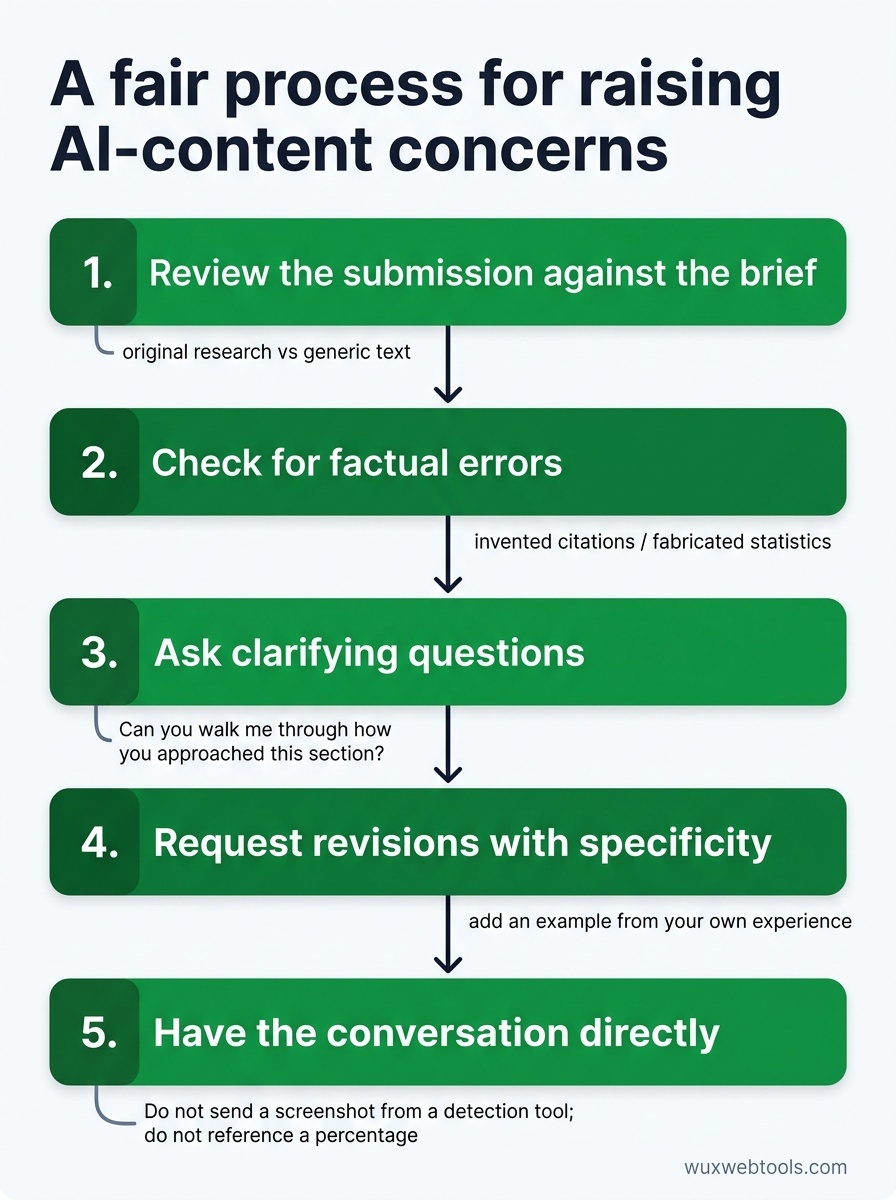
If you suspect a piece was AI-generated, the goal is to verify—not to accuse. Here is a process that respects the contributor while protecting editorial standards:
1. Review the submission against the brief
Does the piece answer the question you asked? Does it include the examples, data, or personal perspective you requested? If the assignment called for original research and the text is entirely generic, that is a problem regardless of whether AI was involved.
2. Check for factual errors
AI models hallucinate. They invent citations, misattribute quotes, and fabricate statistics. If the piece includes claims that do not check out, ask the writer to provide sources. This is standard editorial practice, not an accusation.
3. Ask clarifying questions
If something feels off, ask the writer to explain their thinking. "Can you walk me through how you approached this section?" or "I noticed this phrasing—what did you mean by 'various factors'?" A writer who did the work can usually elaborate. A writer who submitted AI output often cannot.
4. Request revisions with specificity
If the piece is too generic, ask for specifics. "Can you add an example from your own experience?" or "Can you cite a source for this claim?" This gives the writer a chance to improve the work without being accused of anything.
5. Have the conversation directly
If you still have concerns, talk to the writer. Do not send a screenshot from a detection tool. Do not reference a percentage. Say something like: "This piece does not match the style of your previous work, and it does not include the specifics we discussed. Can we talk about what happened?"
Most writers will be honest if you give them a way to be. Some will admit they used AI as a drafting tool and are willing to revise. Some will explain that they were rushed or misunderstood the brief. A few will be defensive. All of these outcomes are better than a false accusation.
When to use detection tools (carefully)
Detection tools have a role, but it is limited. They are useful as a first-pass filter in high-volume environments—admissions offices, content mills, large-scale competitions. They are not useful as evidence.
If you do use a detection tool, treat the result as a reason to look closer, not a verdict. Run the text through multiple tools and compare results. If they disagree (they often do), the score is meaningless. If they agree, you still need human judgment to decide what to do next.
Never show a contributor a detection score. It proves nothing, and it poisons the relationship. If you cannot make the case for AI use without referencing a tool, you do not have a case.
The broader context: disclosure over detection
The long-term solution is not better detection—it is better norms around disclosure. Writers should be expected to state how they used AI, if at all. Editors should be clear about what is acceptable. What honest AI disclosure looks like on a small website offers a workable framework for this.
This requires trust, which is why the detection process matters. If your editorial culture is punitive, contributors will hide their process. If it is collaborative, they will be honest about their tools and methods. The goal is not to eliminate AI use—it is to ensure that published work meets your standards, however it was produced.
Key takeaways
- AI detection tools are not reliable enough to be used as evidence. They produce frequent false positives and should never be the sole basis for accusing a writer.
- The most effective detection method is editorial judgment: knowing your contributors, recognizing style shifts, and spotting generic or vague content.
- If you suspect AI use, verify through clarifying questions and revision requests—not accusations. Most issues can be resolved through conversation.
- Detection tools can be useful as a first-pass filter in high-volume settings, but results should always be confirmed through human review.
- The long-term solution is not better detection, but clearer norms around disclosure and acceptable AI use in your editorial guidelines.
FAQ
Q: Can I trust AI detection tools to be accurate?
No. Current detection tools have false positive rates high enough that they should never be used as sole evidence. They analyze statistical patterns that overlap significantly between human and AI-generated text, especially as models improve. Treat detection scores as a reason to investigate further, not as proof.
Q: What should I do if a writer denies using AI but I am still suspicious?
Focus on the work, not the accusation. If the piece does not meet your editorial standards—too generic, lacks sources, misses the brief—reject it on those grounds. You do not need to prove AI use to enforce quality standards. If the relationship is ongoing, clarify expectations for future submissions.
Q: Is it ever acceptable for writers to use AI as a drafting tool?
That depends on your editorial guidelines. Many publications allow AI for outlining, research, or first drafts, as long as the writer substantially revises and fact-checks the output. The key is disclosure: writers should state how they used AI, and editors should decide whether the final work meets standards.
Q: How do I write editorial guidelines that address AI use fairly?
Be specific about what is acceptable. For example: "Writers may use AI tools for research and outlining, but all final prose must be written and fact-checked by the author. Any AI-generated text that remains in the final draft must be disclosed." Avoid blanket bans, which are difficult to enforce and encourage dishonesty.
Q: What if I get it wrong and falsely accuse someone?
Apologize immediately and clearly. Explain what led to the mistake, acknowledge the harm, and revise your process to prevent future errors. False accusations damage trust, but a sincere apology and process change can sometimes repair the relationship.
<!-- tool-cta:start -->
💡 Try this: For a lower-stakes signal than accusation-prone detectors, the AI Markdown Checker inspects formatting patterns that often hint at AI drafting.
<!-- tool-cta:end -->
Sources
- "AI Text Classifiers Are Really Easy to Fool" — Vice, 2023
- "We Tested AI Detectors. Here's What We Found" — The Verge, 2023
- "The False Positive Problem in AI Detection" — Inside Higher Ed, 2024
- "How to Spot AI-Generated Text: A Guide for Editors" — Columbia Journalism Review, 2023
Frequently asked questions
Can I trust AI detection tools to be accurate?
What should I do if a writer denies using AI but I am still suspicious?
Is it ever acceptable for writers to use AI as a drafting tool?
How do I write editorial guidelines that address AI use fairly?
What if I get it wrong and falsely accuse someone?
Sources & further reading