The hidden cost of AI-generated images on the open web
Every synthetic image carries an energy bill and a training debt. Here's what that means for the web in 2026.
Table of contents
The illusion of zero-cost imagery
AI image generators feel frictionless. You type a prompt, wait fifteen seconds, and get a hero image for your blog post. No photographer to hire, no stock photo subscription, no licensing headaches. The marginal cost appears to be zero.
But that's not how the math works. Every generated image requires meaningful compute—somewhere between 0.3 and 2.9 watt-hours per image, depending on the model and resolution. That's roughly equivalent to charging a smartphone, per image. Multiply that by the millions of images generated daily, and you're looking at the energy consumption of a small city, every single day.
The environmental cost isn't the only hidden expense. There's also the training debt: the fact that these models were built on datasets scraped without consent from artists, photographers, and illustrators who never agreed to have their work used this way. The legal and ethical questions haven't been resolved—they've just been deferred while the technology races ahead.
What the research actually says
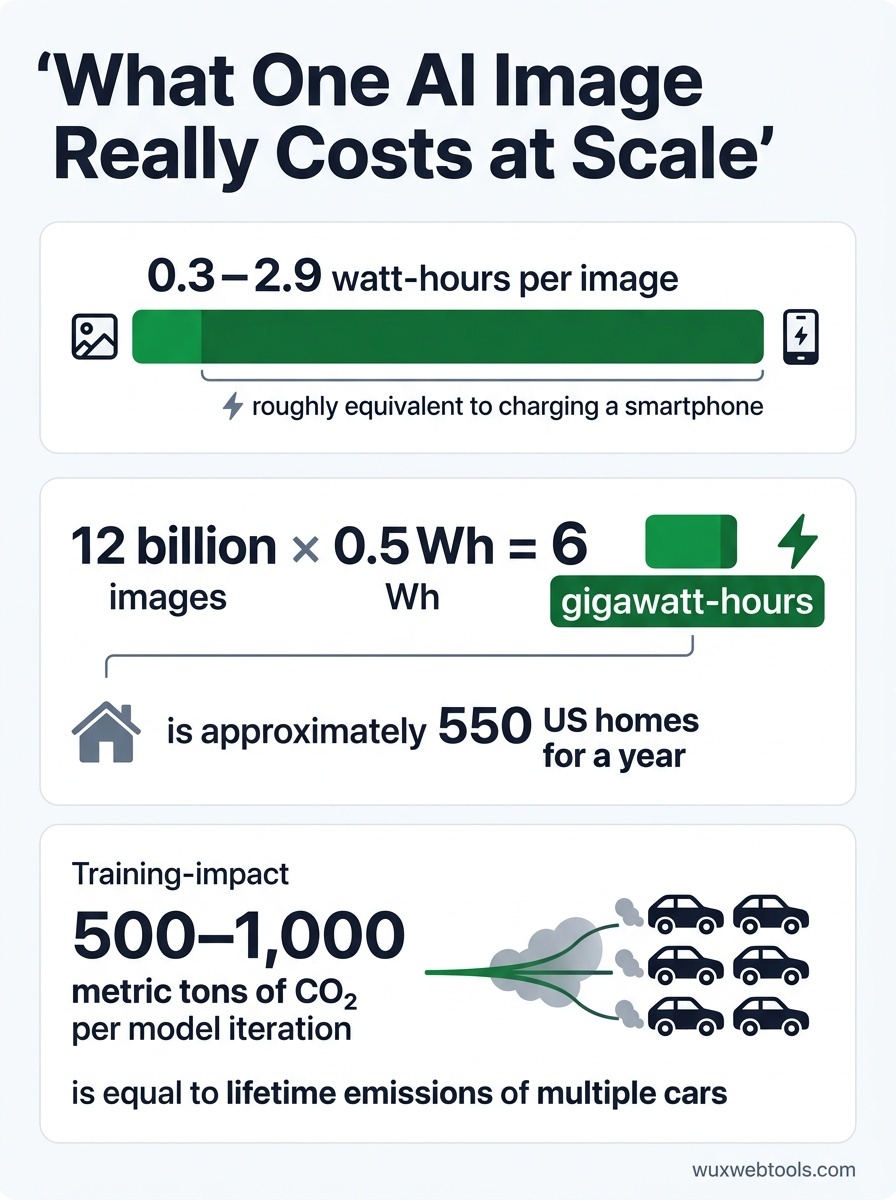
A 2023 study from researchers at Carnegie Mellon and Hugging Face found that generating a single image with Stable Diffusion consumed roughly as much energy as charging a smartphone to full capacity. DALL-E and Midjourney, which run on larger infrastructure, likely consume more.
That might sound trivial until you consider scale. Adobe reported in late 2025 that Firefly had generated over 12 billion images since launch. If each one carried even a conservative 0.5 watt-hours of compute, that's 6 gigawatt-hours—enough to power approximately 550 US homes for a year.
The training phase is worse. Training a large image model like DALL-E 3 or Midjourney v6 requires compute equivalent to the lifetime emissions of multiple cars. OpenAI has not published exact figures, but estimates from AI researchers suggest training costs in the range of 500-1,000 metric tons of CO₂ per model iteration.
Then there's the copyright question. In January 2024, the US Copyright Office reaffirmed that AI-generated images cannot be copyrighted unless they contain sufficient human authorship. Meanwhile, lawsuits from Getty Images, artists' collectives, and individual creators are working their way through courts in the US and EU. The legal landscape remains unsettled, but the direction is clear: using AI-generated images carries reputational and legal risk that didn't exist three years ago.
When synthetic images make sense
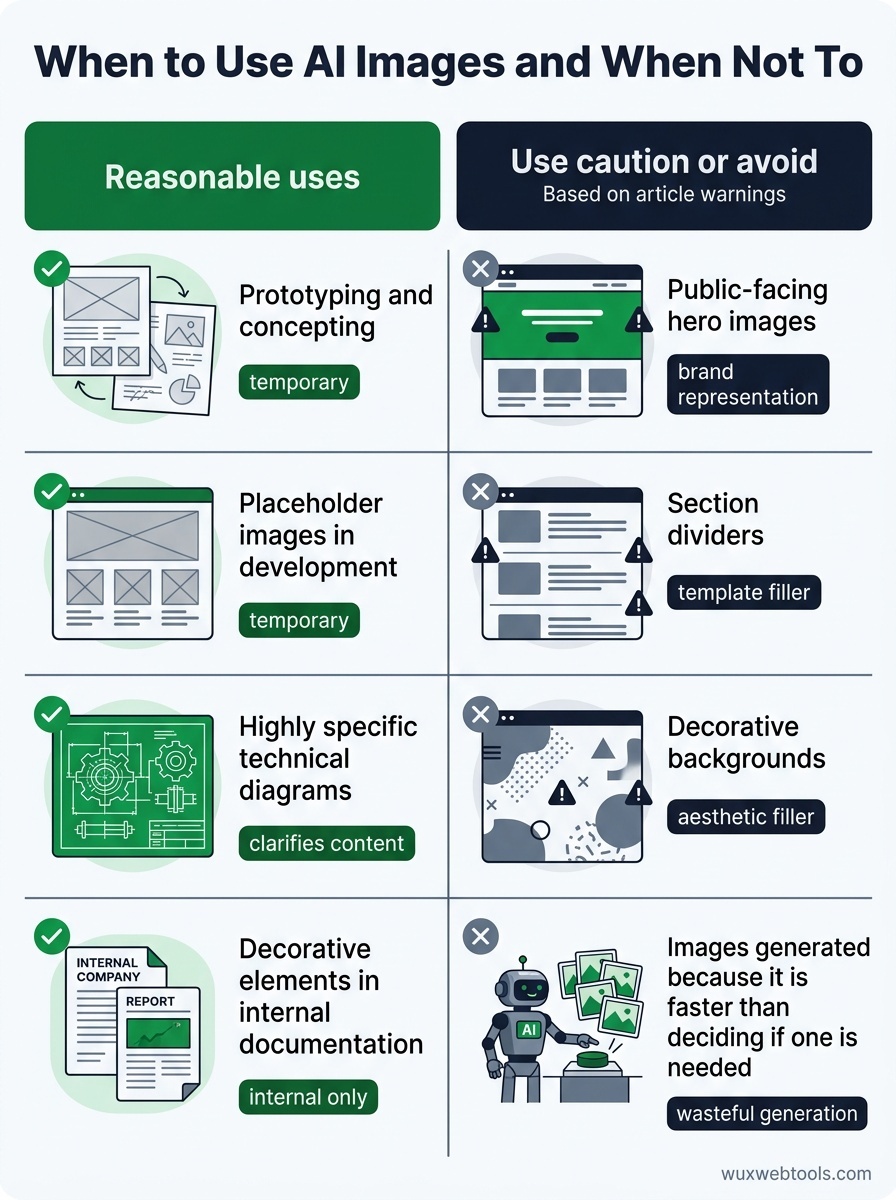
This isn't an argument for never using AI-generated images. There are legitimate use cases where the trade-offs are reasonable:
- Prototyping and concepting before commissioning final artwork
- Placeholder images in development environments that will never ship to production
- Highly specific technical diagrams where stock photography doesn't exist and commissioning custom work is prohibitively expensive
- Decorative elements in internal documentation where visual polish matters but attribution doesn't
The key is intentionality. If you're generating an image because it's faster than thinking about whether you need an image at all, you're probably making the wrong call.
What responsible use looks like in practice
If you do use AI-generated images on a public-facing website, here's a minimum standard that respects both your audience and the broader ecosystem:
Disclose clearly. Don't bury it in a footer or terms of service. If an image is synthetic, say so in the alt text or caption. Readers can handle the truth; they can't handle feeling deceived. We've written about what honest AI disclosure looks like in more detail.
Optimize aggressively. AI-generated images often ship at unnecessarily high resolutions because the generator defaults to 1024×1024 or larger. Run them through proper compression and serve them responsively. If you're generating images client-side, processing them in the browser can reduce server load and improve privacy.
Prefer real images where they exist. Stock photography has its own ethical problems, but at least the provenance is clear and the energy cost is amortized over many uses. If Unsplash has a photo that works, use it.
Write better alt text. AI-generated images are often visually generic, which makes thoughtful alt text even more important. A decorative hero image of "a futuristic cityscape" doesn't need a novel, but it does need enough context that a screen reader user understands why it's there. Our guide to alt text in 2026 covers this in depth.
The sustainability question nobody wants to answer
The AI industry's response to energy concerns has been to promise future efficiency gains. Models will get smaller, hardware will get faster, renewable energy will offset the carbon. All of that is probably true, but it doesn't address the fundamental issue: we're adding a new energy-intensive layer to every creative decision on the web.
The web's carbon footprint has been growing for years, driven by heavier JavaScript bundles, more video, more tracking scripts. AI-generated images are the latest addition to that pile. The question isn't whether the technology will improve—it will. The question is whether we're willing to add this cost to every blog post, every product page, every landing page, just because we can.
The honest answer is that most sites don't need as many images as they currently use. Hero images, section dividers, decorative backgrounds—most of them are there because visual templates expect them, not because readers need them. AI generation makes it easier to fill those slots, but it doesn't make the slots necessary.
<!-- tool-cta:start -->
💡 Try this: If you are auditing image sources for AI-generated content, the AI Image Detector can flag likely synthetic images before you publish them.
<!-- tool-cta:end -->
A workable standard for 2026
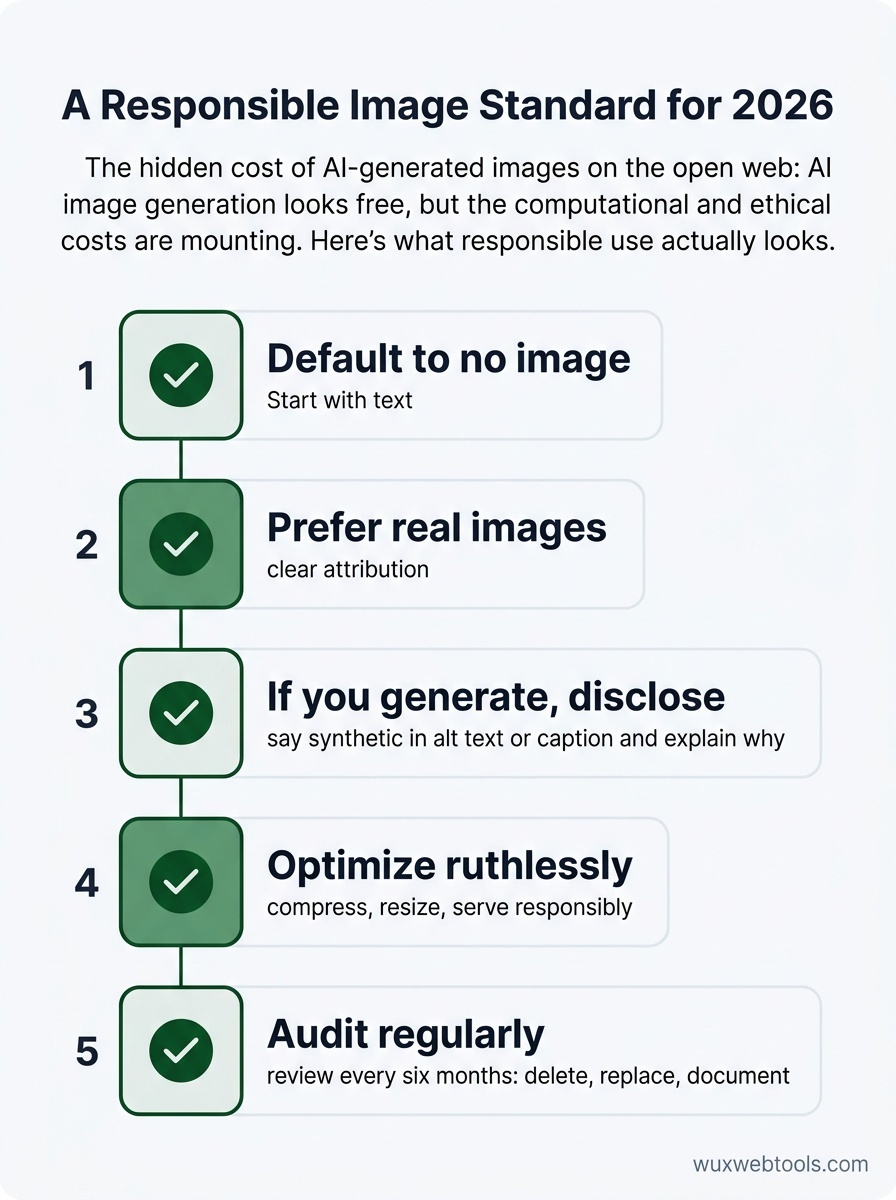
Here's a practical framework that balances utility with responsibility:
- Default to no image. Start with text. Add an image only when it genuinely clarifies or enhances the content.
- Prefer real images. Use photography, illustrations, or diagrams created by humans, with clear attribution.
- If you generate, disclose. Make it obvious that the image is synthetic, and explain why you chose generation over alternatives.
- Optimize ruthlessly. Compress, resize, and serve images responsibly. Every kilobyte you don't ship is energy you don't spend.
- Audit regularly. Every six months, review your image library. Delete what you don't need, replace what you can, and document what you can't.
This isn't a purity test. It's a recognition that every technical decision carries a cost, and that transparency is the minimum price of using tools with unresolved ethical and environmental debts.
The web doesn't need fewer images. It needs more intentional ones.
Frequently asked questions
Is it legal to use AI-generated images on my website?
How much energy does AI image generation actually use?
Should I stop using AI-generated images entirely?
What counts as proper disclosure for AI-generated images?
Sources & further reading